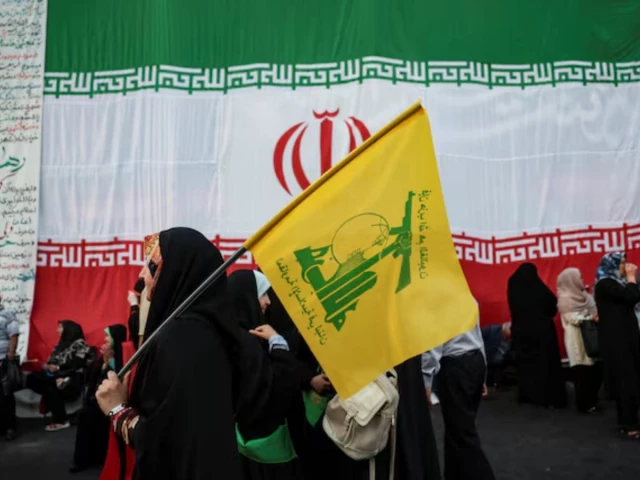


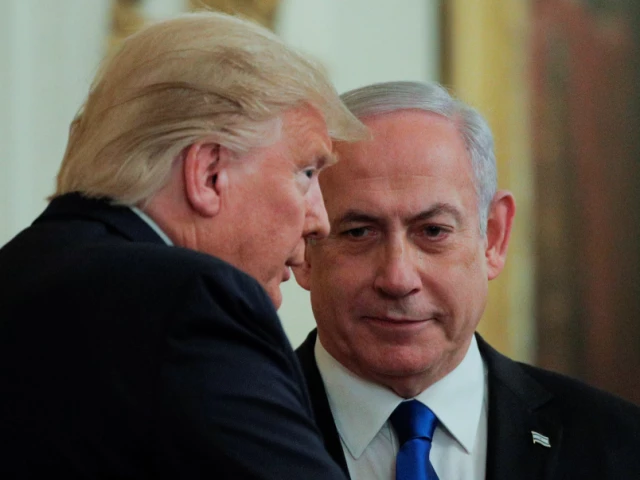
Israeli Prime Minister Benjamin Netanyahu said Thursday that he welcomed “all help” with destroying Iran’s nuclear sites, while Trump said he will decide whether to attack Iran within the next two weeks due to a “substantial” chance of negotiations. PHOTO:REUTERS
Benjamin Netanyahu has long portrayed himself to the Israeli public as being uniquely adept at dealing with Donald Trump, capable of winning and sustaining the US president’s backing.
But an acrimonious phone call this week, where the president called the prime minister “f***ing crazy”, first leaked to the media by an Axios report and later publicly confirmed by Trump, laid bare the strains that have at times emerged between the two leaders.
Israeli officials, speaking on condition of anonymity, acknowledged the call was among the most heated the premier has had with Trump. One of the officials said the leak had damaged Netanyahu politically ahead of this year’s national election.
The US website Axios broke news of the call on Monday, saying Trump had angrily confronted Netanyahu over Israeli threats to resume air strikes on Beirut’s southern suburbs. “Everybody hates you now. Everybody hates Israel because of this,” Trump was quoted as saying.
Read: Israeli army warns residents of 3 Lebanese towns to evacuate despite renewed ceasefire
The US president told Netanyahu not to target Beirut after Iran had warned that Israeli strikes in Lebanon were undermining talks to end the war, which began with joint US-Israeli attacks and which is deeply unpopular among Americans.
US-Israel differences ‘now very public’, says think-tank head
A senior Israeli official told Reuters that Netanyahu had made clear to Trump that any pause in Israeli plans to strike Beirut would only work if Hezbollah stopped hitting northern Israel. Trump was receptive to this position, the official said.
Following their call, Trump said Israel and Hezbollah had agreed to stop shooting at each other, prompting accusations by Netanyahu’s political opponents, and some within his own government, that he had ceded Israel’s sovereignty to the US.
“A total protectorate,” said opposition leader Yair Lapid, suggesting Netanyahu had put Israel in the position of an American client state.
Netanyahu, Israel’s longest-serving prime minister, has repeatedly clashed with Republican and Democratic administrations. Yet, Israel has remained Washington’s closest Middle East ally.
Nimrod Goren, the president of Mitvim, an Israeli think tank, said “the differences are now very public”, unlike in the past when they were usually quietly managed behind closed doors.
Trump told the New York Post on Wednesday that he was “a little bit perturbed” by Netanyahu constantly attacking Lebanon, but added: “We’ve worked very well together.”
Trump’s decision to join Israel in striking Iran, not once but twice in the space of a year, appeared to mark a major victory for Netanyahu, who had spent decades urging Washington to use its military power to halt Tehran’s nuclear programme.
But Trump has also taken a series of steps that many in Israel have viewed as cutting against the country’s interests, including ending US strikes on Yemen’s Iran-backed Houthis, lifting sanctions on Syria’s President Ahmed al-Sharaa, and ordering a halt to Israel’s 12-day war with Iran in June 2025.
Israel not directly involved in US-Iran peace talks
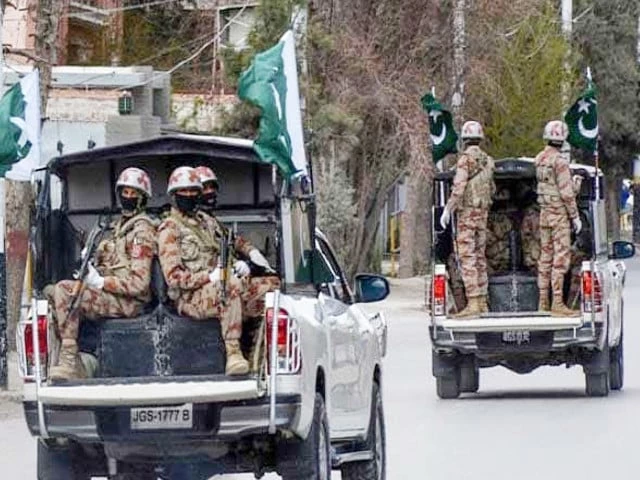
And while the United States and Israel jointly launched the campaign against Iran in February, Israel has not been directly involved in the US-Iran talks to end the war. Those negotiations have been conducted through Pakistan, a rare intermediary that has no formal diplomatic ties with Israel.
The wars with Iran and Hezbollah have been widely popular in Israel, including among supporters of Netanyahu’s political rivals, and much of the public wants the fighting to continue.
That stands in contrast to the US, where many voters —including members of Trump’s conservative base — oppose the war.
Trump has repeatedly said that the US was close to an agreement with Iran on ending the war. Tehran insists any deal include Israel halting attacks on its ally Hezbollah in Lebanon.
“We are basically being forced to stop,” said Israeli pollster Mitchell Barak. “We don’t have a say in this anymore.”
At the start of this year’s war with Iran, Netanyahu said that the Iranian government would be toppled, and its nuclear and missile programs destroyed. He has also said that Hezbollah, which attacked Israel in March in support of Iran, must be disarmed in southern Lebanon. So far, none of these goals has been achieved.
Recent domestic polls have repeatedly shown that Netanyahu’s coalition government, the most right-wing in the country’s history, would fail to win a majority at the next election.
Netanyahu, Goren said, was working to accommodate Trump’s demands because the Israeli premier will need the president’s support closer to the elections, including a possible visit by the US leader to Israel. Before the war with Iran, Trump was widely expected in Israel to visit in April to be awarded the state’s highest civilian honour. He last visited in October.
Notion of Trump-Netanyahu rift overstated, ex-adviser says
But some Israelis were not comfortable with the extent to which Trump appears able to influence Israeli military decisions, Goren said. In contrast, in the US, some Trump critics say that Netanyahu has outsized influence on US foreign policy.
Itamar Ben-Gvir, Netanyahu’s national security minister, said on Thursday that there are times when an Israeli leader must know how to say “no” even to the US president.
Nadav Shtrauchler, a former Netanyahu adviser, said the Israeli premier was counting on Trump’s support in the election.
“The way the war (with Iran and Hezbollah) will end will affect, more than anything, the result of the election.”
Trump has often lavished public praise on Netanyahu and has publicly lobbied Israel’s president to pardon the prime minister, who is on trial in Israel on corruption-related charges.
But Trump has also publicly emphasised how much, he says, Israel needs Washington, and has used expletives in the past when talking about Israel, including publicly saying last year that Israel and Iran “don’t know what the fuck they are doing.”
For his part, Netanyahu describes Trump as “the greatest friend Israel has ever had in the White House”, offering the kind of public praise that resonates with the Republican president, who is known to prize personal loyalty and validation.
Since the US and Israel opened the war with Iran, Netanyahu has at times said that he speaks with Trump almost daily, often characterising their relationship to the Israeli public as one between peers who make decisions together.
Asked about the call in an interview with CNBC on Wednesday, Netanyahu said that like in the “best of families” there at times had been “tactical disagreements” with the US president.
A US official told Reuters the phone call was one of several in which the president has been very direct with Netanyahu but that the two remain friends and close allies.
“Their conversations are pretty direct,” the official said.
The official, and another Israeli source briefed on the US-Israel relationship, dismissed any suggestion of a material change in the relationship between Netanyahu and Trump.
However, the Israeli source acknowledged that the leak of the call – and Trump’s subsequent confirmation of it – was not helpful to Netanyahu ahead of an election that he is polling to lose.
Shtrauchler, the former adviser to Netanyahu, said the perception of a rift with Trump was overstated and that the two leaders still appeared to remain aligned on most major issues.
But an abrupt end to the wars with Iran and Hezbollah, however, would pose a “huge problem” for Netanyahu, he said, as many Israelis would see it as Trump having forced his hand.
“No one wants here to feel like we are another star on the (US) flag. We want to feel independence,” Shtrauchler said.