
Iran says Washington’s shifting, contradictory positions remain the biggest hurdle in US negotiations
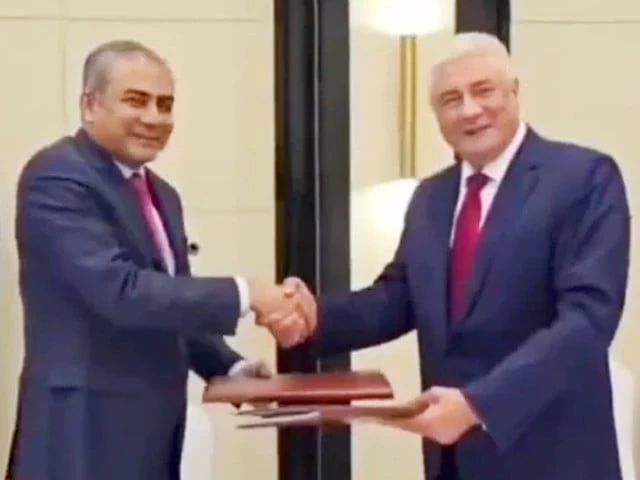
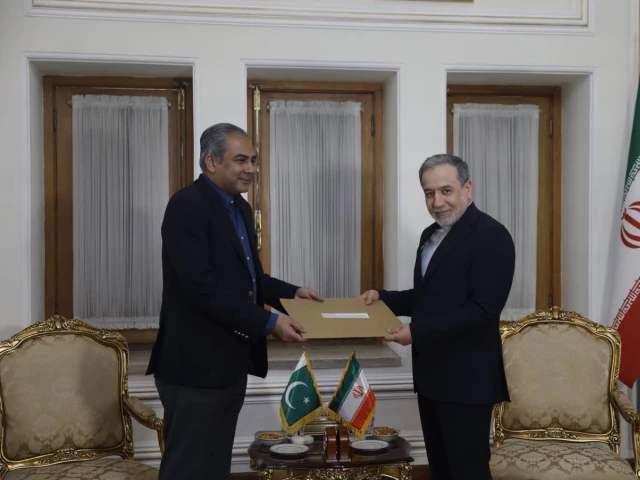
Naqvi meets Iran’s FM Araghchi. Photo: X
Interior Minister Mohsin Naqvi on Sunday met Iranian Foreign Minister Abbas Araghchi in Tehran to discuss issues of mutual interest and strengthen cooperation between the two neighbouring countries, Iranian media reported.
The meeting focused on enhancing bilateral ties and expanding collaboration across key areas of shared concern.
According to Iran’s state news agency IRNA, Naqvi arrived in Tehran on Saturday, carrying what an informed source described as an important message from Chief of Defence Forces Field Marshal Syed Asim Munir to Iran’s Supreme Leader Ayatollah Seyyed Mojtaba Khamenei.
Iran’s Press TV reported that Naqvi was received by his counterpart, Eskandar Momeni.
According to the source, the interior minister has been entrusted with delivering a message from Field Marshal Asim Munir to Iran’s Supreme Leader, Ayatollah Seyyed Mojtaba Khamenei, during his visit to Tehran.
The source further said that Prime Minister Shehbaz Sharif provided Naqvi with special instructions concerning ongoing discussions related to Iran-US talks, highlighting Islamabad’s close attention to developments affecting regional stability and diplomacy.
Naqvi’s visit is being closely watched in diplomatic circles as Pakistan and Iran continue to engage on a range of bilateral and regional issues, including security cooperation and broader geopolitical developments in the region.
Iran cites shifting US positions as main obstacle in talk
Iran’s main challenge in negotiations with the United States is Washington’s changing and contradictory positions, Foreign Ministry spokesman Esmaeil Baghaei said on Sunday.
Speaking to CNN in Tehran, Baghaei said the exchange of messages between the two sides continued through Pakistani mediators.
“The main problem of negotiating with this administration is that you have to face so many changing positions, moving the goal posts, different statements, contradictory remarks by different officials,” he said, adding that this made the process “very cumbersome”.
Baghaei said there were several sticking points in the talks, but stressed that “the Americans must understand that they have to recognise Iran’s rights”, including its right to peaceful nuclear enrichment under the international non-proliferation treaty.
He also criticised the US position on Iran’s frozen assets, saying Washington was unwilling to make concessions while discussing the issue.
Iran is seeking the release of billions of dollars in assets frozen in foreign banks.
US eyes Iranian assets for Gulf allies’ reconstruction, source says
The US government will attempt to redirect Iranian assets to Gulf states for rebuilding and repairs of damage caused by Iran, a source familiar with the matter said, as Tehran followed up a wave of strikes against Kuwait and Bahrain with further drone launches.
Treasury Secretary Scott Bessent has directed a team to assess costs for damage inflicted on Gulf allies by Iran, the source said on Saturday, adding the US will consider using Iranian assets for repairs of any future destruction as well.
The disclosure came a day after Mohsen Rezaei, an adviser to Iran’s supreme leader, told CNN that a peace deal to end the three-month war hinged on the release of $24 billion in Iranian assets frozen by the United States.
Negotiations appear stalled
The source did not specify what kind of assets the Treasury was examining. The language used to describe the new measures did not appear limited to frozen assets.
The threat to redirect Iranian assets could create a new irritant to a fragile ceasefire between the United States and Iran, which was tested again this weekend with strikes by both nations.
Peace negotiations appear to have stalled, although a minister from mediator Pakistan traveled to Tehran on Saturday with a letter for Iran’s supreme leader, Ayatollah Mojtaba Khamenei, Iran’s semi-official ISNA news agency reported.
US forces struck Iranian coastal radar sites in Goruk and Qeshm Island, both in the Strait of Hormuz, early on Saturday after shooting down drones launched by Iran that US Central Command says posed a threat to maritime traffic. Two more Iranian attack drones that were threatening shipping in the strait were shot down, the US military said late on Saturday.
Read: US, Iran launch new strikes
Iran’s Revolutionary Guards said it retaliated against US bases in Kuwait and Bahrain, and Kuwait’s army said it engaged seven ballistic missiles that passed over residential areas, resulting in material damage but no casualties.
In Bahrain, sirens sounded and residents were urged to seek shelter. Kuwait and Bahrain condemned the strikes.
Iran later said it had hit US bases in both countries with ballistic missiles, but the US military said six missiles were intercepted and a seventh did not reach its target.
OPEC+ eyes another output hike, but war thwarts shipments
The US and Iran have engaged in largely indirect negotiations for an interim deal to halt the three-month-old war that would leave issues including Iran’s nuclear program to further negotiations.
But a deal has remained elusive while the two sides have periodically skirmished.
Tehran wants access to billions of dollars in oil revenue, waivers on sanctions on crude exports, the lifting of a US blockade on its ports and leverage over the Strait of Hormuz. Iran has effectively blocked the waterway, where about a fifth of global oil traffic transited before the war.
President Donald Trump is facing mounting domestic political pressure due to rising gas prices to bring the unpopular war to an end. He told NBC that while most of Iran’s drone and missile manufacturing facilities had been destroyed, the Iranians still had access to about a fifth of their missiles.
“They have some missiles, they have some drones. I would say percentage wise, maybe 21% to 22% of their missiles. It’s a lot of missiles, but it’s not what it was when we first attacked,” Trump told NBC News‘ “Meet the Press” program, according to excerpts released by the network on Friday.
The conflict has driven up oil prices and fueled inflation around the globe. OPEC+ is set to agree on Sunday a fourth increase in oil output targets in as many months, three sources in the oil-producing group said, even though the war is still preventing several of the group’s members from pumping more.
All Iranian officials aligned on negotiating strategy, says vice president
Vice President Mohammad Reza Aref has said all senior Iranian officials are fully aligned on the country’s negotiating strategy, dismissing any suggestion of differences over the text or proposals under discussion, IRNA news agency reported.
Speaking during a visit to the Islamic Republic of Iran Customs Administration on Saturday, Aref said Tehran has pursued a clear and coordinated approach in negotiations.
“The Islamic Republic of Iran has had a specific strategy in the negotiations, and all officials have pursued it with complete coordination,” he said, adding that there were “no differences regarding the text and proposals of the negotiations.”
He was referring to ongoing indirect talks between Iran and the United States aimed at ending the US-Israeli war of aggression against the country, which began on February 28 with the assassination of Leader of the Islamic Revolution Ayatollah Seyyed Ali Khamenei and several top military commanders.
Aref also highlighted Iran’s experience in managing two imposed wars, saying the country had gained valuable lessons in crisis management.
He noted that wartime conditions had led to the removal of certain bureaucratic procedures, with increased efficiency in imports, cargo unloading and customs clearance.
The vice president also called for expanding the capacity of customs offices and ports across the country, and urged the completion of the North–South and East–West transport corridors.
He added that Iran’s strategy of strengthening relations with neighbouring countries had gained greater momentum since the Ramadan war, stressing the need to focus on regional opportunities in national planning.
Israeli military says it intercepted two projectiles
The Israeli military said it intercepted two projectiles that crossed into Israeli territory from Lebanon on Sunday, after sirens sounded in the areas of Yiftah and Ramot Naftali.
Clashes between Israel and Hezbollah have not halted, with the Lebanese militant group rejecting proposals linking a ceasefire to its disarmament, saying Israel must first halt its attacks and withdraw its forces from southern Lebanon.
Four Israeli soldiers injured in southern Lebanon
The Israeli military says four Israeli reserve soldiers were moderately injured in a drone attack in southern Lebanon, according to the Israeli media, Al Jazeera reported.
The report came a day after the Israeli military announced the deaths of two soldiers in fighting in southern Lebanon.
At least 29 Israeli soldiers and one contractor have been killed since hostilities between Israel and Hezbollah resumed on March 2, AFP reported.
Palestine condemns Iran missile attacks on Bahrain and Kuwait
Palestinian foreign ministry condemned Iran’s recent missile attacks on Bahrain and Kuwait, calling them “an escalation in threatening security and stability in the Arabian Gulf region” and “a direct assault on their security and safety,” Al Jazeera reported.
The ministry said the attacks represented a “blatant breach” of the United Nations Charter, international law and international norms.
It also expressed Palestine’s “full solidarity” with Bahrain and Kuwait and backed “all legitimate measures” taken to protect their sovereignty, security and stability.
تعرب وزارة الخارجية والمغتربين عن إدانة دولة فلسطين الشديدة للاعتداء الإيراني الذي استهدف مملكة البحرين ودولة الكويت، عبر إطلاق سبعة صواريخ بالستية باتجاه أراضيهما فجر يوم السبت، حيث جرى اعتراضها وإسقاطها.
وتؤكد الوزارة أن هذا الاعتداء يمثل انتهاكاً صارخاً لسيادة البلدين… pic.twitter.com/I4pRgpu6xQ
— State of Palestine – MFA 🇵🇸🇵🇸 (@pmofa) June 6, 2026
As OPEC+ meets, Iran war hobbles power to shape oil market
OPEC+ ministers meet Sunday to weigh higher production quotas in a bid to cap oil prices that have surged since the Iran war effectively choked off Gulf crude shipments, AFP reported.
But even if the cartel members vow to ramp up output by thousands of barrels per day, analysts say geopolitical realities mean they probably won’t move the needle on prices.
Ministers from the 21 member states of OPEC+, the main oil producing nations and their allies, are holding their quarterly meeting online.
The group is likely to beef up its production quotas by “188,000 barrels a day”, said Jorge Leon, analyst at Rystad Energy, similar to recent increases.
Fighting flares across region despite ceasefire
In a parallel conflict in Lebanon, two Lebanese army officers and a soldier were killed in an Israeli strike on a military vehicle in south Lebanon, the Lebanese army said. The Israeli military said it was investigating the incident.
Iran has made a ceasefire in Lebanon between Israel and Iran-aligned Hezbollah a condition for any peace deal with Washington.
Lebanon’s army said on Saturday its commander, General Rudolf Haykal, left for Pakistan at the invitation of his Pakistani counterpart, without giving further details.
The surprise visit was notable given the insistence by Washington — and by Lebanese leaders, including the president — that ceasefire talks for Lebanon remain separate from US-Iran negotiations mediated by Pakistan.
Also read: Lebanese army officer, soldiers killed in Israeli strike amid ceasefire tensions
Hezbollah leader Naim Qassem this week rejected a US-brokered pact between Israel and the Lebanese government to halt the fighting in Lebanon. The deal did not provide for an Israeli withdrawal and Hezbollah had not been party to the negotiations.
Israel has said its forces would not withdraw or halt operations in the country amid increasing friction with the US.