
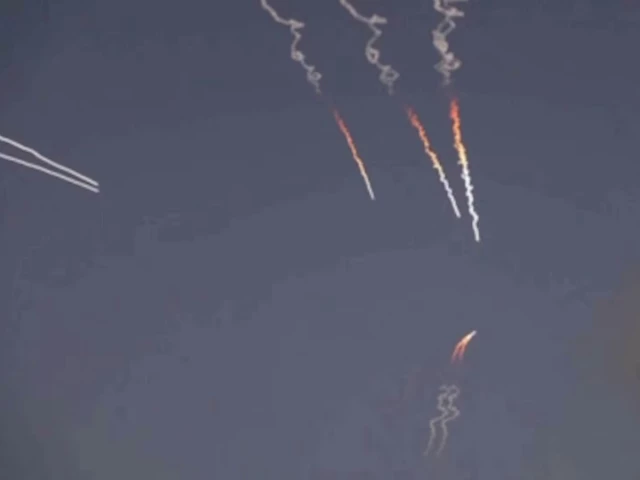
Iranian missiles are launched, as Iran’s Revolutionary Guards said they had carried out attacks against a U.S. base in Jordan and 21 other targets in the Gulf on Wednesday in retaliation for American strikes around the Strait of Hormuz, from a location given as Tehran, Iran, released June 10, 2026, in this still image taken from a video. PHOTO: REUTERS
Iran’s military said on Wednesday that all US bases across the region would become “legitimate targets” for its drones if Washington continues violating a ceasefire agreement, Iranian state media reported.
In a statement carried by state broadcaster IRIB, the army said it had targeted what it described as gathering centers of US forces at Sheikh Isa Air Base in Bahrain earlier on Wednesday.
The army said the attack was carried out in response to US “hostile aggression against military and civilian areas in the southern part of the country” and violations of the 14 articles of the ceasefire agreement.
“The consequences of repeatedly and blatantly violating the ceasefire with criminal America will be that all American bases in the region will be legitimate targets for the Army’s drones,” the statement said.
New attacks on Iran were absolutely necessary, NATO chief says
The new attacks by the US on Iran were “absolutely necessary”, NATO Secretary General Mark Rutte said on Wednesday.
“When you have a ceasefire and Iran is basically violating the ceasefire, I think it is totally crucial that the US forcefully react,” Rutte told reporters before a summit of NATO leaders in Ankara.
Iran claims downing of US MQ-9 drone over Bushehr province
Iran’s Islamic Revolutionary Guard Corps (IRGC) claimed it shot down a US MQ-9 drone over Khormoj in the southern province of Bushehr early Wednesday, Iranian state media reported.
State broadcaster Press TV said the drone was intercepted and destroyed by an air defense system following what it described as “aerial aggression” by US forces over Bushehr province.
No further details were immediately available about the circumstances of the incident.
There was no immediate comment from US authorities on the Iranian claim.
Iran’s parliament speaker accuses US of major ceasefire violations after renewed strikes
Iranian Parliament Speaker Mohammad Bagher Ghalibaf accused the United States of committing major violations of the ceasefire deal between the two countries known as the Islamabad Memorandum of Understanding following renewed US strikes against Iran.
In a post Wednesday on the US social media platform X, Ghalibaf listed what he described as US violations, including “persistent threats of further strikes,” the reinstatement of oil sanctions, attacks on southern Iran, and continued Israeli military action in Lebanon.
Major MOU Violations by the US:
Violating Iranian adjustments in the Strait
Persistent threats of further strikes
Reinstating oil sanctions
Attacks on southern Iran
Continued Zionist aggression on🇱🇧
The era of bullying and extortion is over. It leads nowhere. We don’t fold.
— محمدباقر قالیباف | MB Ghalibaf (@mb_ghalibaf) July 8, 2026
“Major MOU Violations by the US,” he wrote. “The era of bullying and extortion is over. It leads nowhere. We don’t fold.”
The statement came shortly after the US military said it had completed a new round of strikes against Iran, hitting more than 80 targets in response to Tehran’s latest attacks on commercial vessels transiting the Strait of Hormuz.
Iran targets sites in Bahrain, Kuwait after wave of US strikes
Iran’s Revolutionary Guards said they targeted US military sites in Bahrain and Kuwait on Wednesday after the US launched a wave of military strikes on Iran in response to attacks on tankers in the Strait of Hormuz.
In the latest blow to the fragile ceasefire agreement, the Islamic Revolutionary Guard Corps said it carried out a joint missile and drone operation against key US military sites in Bandar Salman, Bahrain’s Fifth Naval District and Ali Al Salem Air Base in Kuwait, and shot down a US MQ9 drone attempting to interfere in the operation.
Explosions reported in several areas of southern Iran
Explosions were reported early on Wednesday in several areas of southern Iran, according to Iranian state media.
Iranian state television reported six explosions in the southern port city of Bandar Abbas.
Iran’s Fars News Agency said 10 explosions were heard in the southern city of Sirik and four others in Misin village on Qeshm Island.
No casualties or damage were immediately reported.
US and Iran exchange fire again after attacks in Hormuz strait
The US military launched a series of strikes against 80 Iranian targets early on Wednesday hours after revoking a temporary sanctions waiver for oil export, following three tankers were struck in the Strait of Hormuz, the US Central Command (CENTCOM) said.
In a statement posted to social media, CENTCOM said American forces launched the strikes “to impose heavy costs for targeting and attacking commercial shipping crewed by innocent civilians in an international waterway in unwarranted, dangerous, and a clear violation of the ceasefire”.
Earlier on Tuesday, the US Treasury Department canceled a license announced in June that had allowed Iran to produce, sell and deliver crude oil and related products through August 21. “Iran’s actions in the Strait were wholly unacceptable to the United States and will be met with consequences,” a US official said.
The official told AFP that the US-Iran memorandum of understanding was “entirely performance-based,” warning that Tehran would see benefits only if it showed “good behaviour.” But US negotiators were continuing to work “in good faith towards a final deal,” the official said.
British maritime security agency UKMTO said an “unknown projectile” hit a tanker overnight, causing a fire, before two more vessels were struck, at least one by a drone. All three vessels were struck close to Oman. Qatar said one of the vessels was its LNG tanker and blamed Iran for “unacceptable” attack.
The announcement came as US President Donald Trump landed in the Turkiye capital Ankara for a two-day meeting of the heads of state and government of the member states of NATO, the first gathering of the Alliance members since the Iran war.
In Ankara, Trump overshadowed the summit with fresh criticism of alliance members, a renewed demand for US control of Greenland, a pledge to lift sanctions on Turkiye and signals that Washington could allow Ankara back into the F-35 fighter jet programme.
Against a backdrop of lingering tensions within the alliance following the US strikes on Iran, NATO leaders unveiled defence deals worth tens of billions of dollars, seeking to demonstrate they were responding to American demands for greater military spending.
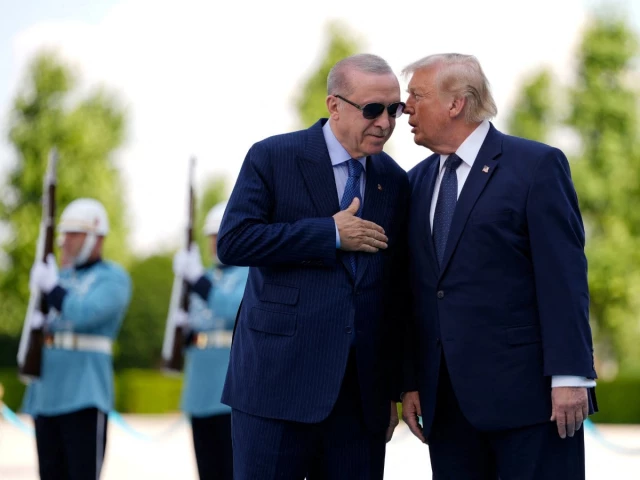
Meeting host President Recep Tayyip Erdogan at the presidential complex in Ankara, Trump announced that the United States would remove sanctions imposed on Turkiye under the Countering America’s Adversaries Through Sanctions Act (CAATSA) after Ankara purchased Russian S-400 air defence systems in 2020.
He also indicated that his administration would decide on a potential sale of F-35 stealth fighter jets to Turkiye, a move that would reverse one of the most contentious disputes between the two NATO allies, although legal and congressional hurdles remain.
Repeating his long-standing complaints that European allies had failed to shoulder a fair share of collective defence responsibilities, he said he remained disappointed with NATO, singling out Britain, France, Germany and Italy for “inadequate support” during the US military campaign against Iran.
Despite his criticism of European allies, Trump expressed optimism about efforts to end the war in Ukraine, saying he had spoken separately with Russian President Vladimir Putin and Ukrainian President Volodymyr Zelenskiy before the summit.
Speaking alongside Erdogan, Trump also reignited controversy by renewing his insistence that Greenland should come under US control. He argued that the strategically located Arctic island should be controlled by the United States rather than Denmark, saying Copenhagen had failed to adequately support Greenland.
The remarks drew an immediate response from Danish Prime Minister Mette Frederiksen, who said allies should respect the sovereignty of the Danish kingdom and reiterated that Greenland was not for sale. Greenland’s Foreign Minister Mute Egede also rejected Trump’s comments, saying the island’s future would be decided solely by its own people while continuing close cooperation with allies.
Ahead of Trump’s arrival, NATO Secretary General Mark Rutte, addressing a defence industry forum on the sidelines of the summit, sought to reassure Washington that European allies were significantly increasing defence investment.
He called for a “revolution” in the alliance’s defence industrial base, warning that the security environment required a rapid expansion of military production to counter threats from Russia as well as challenges posed by China, North Korea and Iran.
NATO announced defence initiatives and procurement agreements estimated to be worth at least $50 billion. The deals included European countries purchasing surveillance drones from US defence company Northrop Grumman and NATO acquiring aircraft from Sweden’s Saab.
A draft agreement was also signed between Lockheed Martin and Rheinmetall to jointly produce ATACMS missiles in Germany, marking the first planned production of the missile system outside the United States. Rutte said NATO allies would invest more than $40 billion over the next five years in anti-drone capabilities.
The summit also highlighted continuing anxiety over Ukraine. NATO members are expected to reaffirm their support for Kyiv and pledge $70 billion in assistance for 2026, while Zelenskiy has appealed for additional air defence systems amid intensified Russian attacks.
Trump’s visit to Ankara was accompanied by an elaborate state welcome organised by Erdogan, featuring mounted guards, military honours and fighter jet flypasts at the sprawling presidential complex. The display reflected the close personal rapport between the two leaders.
Although NATO leaders sought to present a united front in Ankara, the summit again exposed the difficult balance between accommodating Trump’s demands for greater European military contributions and preserving alliance cohesion at a time of growing geopolitical uncertainty.
While major defence spending commitments and new arms deals demonstrated movement towards Washington’s objectives, disagreements over Greenland, the aftermath of the Iran conflict and the future of US engagement in Europe ensured that familiar tensions continued to shape the alliance’s agenda.
Qatar urges Iran to halt threats to maritime security after attack on Qatari vessel near Hormuz
Qatar condemned on Tuesday an Iranian attack on a Qatari vessel near the Strait of Hormuz, calling on Tehran to immediately halt actions threatening maritime security and global energy supplies.
In a statement on the US social media company X, Foreign Ministry spokesman Majed al-Ansari said the targeting of the Qatari-owned LNG carrier Al Rekayyat as it was transiting near the strategic waterway constituted “an unacceptable attack on the security and safety of international maritime navigation.”
The targeting of the Qatari vessel “Al-Rekayyat” while transiting near the Strait of Hormuz constitutes an unacceptable attack on the security & safety of international maritime navigation, the security of global energy supplies, & a grave & explicit violation of international…
— د. ماجد محمد الأنصاري Dr. Majed Al Ansari (@majedalansari) July 7, 2026
He said the attack also threatened global energy supplies and amounted to “a grave and explicit violation of international law,” particularly the rules guaranteeing freedom of navigation and safe passage through international waterways.
“We demand that the Islamic Republic of Iran immediately cease all practices that undermine regional security or threaten the safety of international maritime navigation and refrain from endangering global energy supplies and the resources of the countries of the region in pursuit of narrow interests,” Ansari said.
He added that Qatar holds Iran “fully legally responsible” for the attack and for any resulting damage and consequences.
The Al-Rekayyat vessel was reportedly among two commercial vessels struck near the Strait of Hormuz by Iranian missiles while transiting the waterway late Monday, causing significant damage but no casualties.
Iran’s state broadcaster IRIB, citing unnamed sources, claimed that a Qatari oil tanker attempting to transit the Omani route through the Strait of Hormuz with US Navy support was targeted after ignoring repeated warnings from Iranian forces.
The Strait of Hormuz is one of the world’s most important energy chokepoints, carrying a significant share of global oil and liquefied natural gas exports from Gulf producers.