Key ministries exceed budget authorisations, putting IMF-mandated primary surplus target at risk
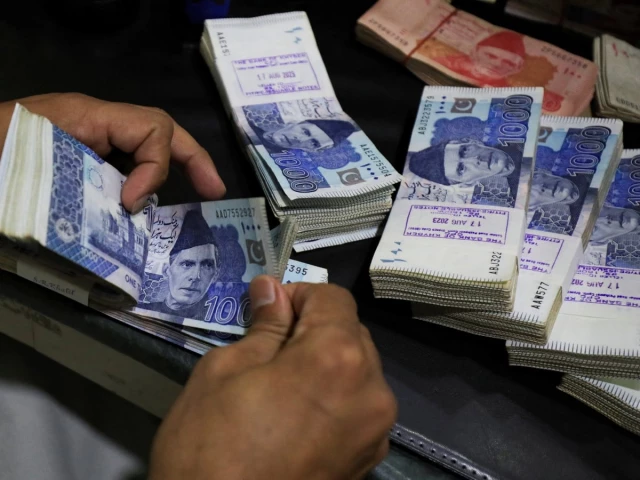
An employee counts Pakistani rupee notes at a bank in Peshawar, Pakistan August 22, 2023.Photo: Reuters
ISLAMABAD:
The federal development spending shot up to Rs912 billion, exceeding the downward revised allocation by Rs92 billion, after key ministries incurred more expenses than their authorisations and put the annual budget surplus condition to a test.
The provisional spending estimates show that, as against the twice-downward revised allocation of Rs820 billion, the Public Sector Development Programme (PSDP) expenditures remained at Rs912 billion for the fiscal year 2025-26, which ended on June 30.
The government had slashed the development budget by Rs180 billion, or 18% of the annual allocations, to offset the impact of the Middle East conflict on the primary budget surplus condition agreed with the International Monetary Fund (IMF) before the war.
The PSDP had been diverted towards picking up fuel subsidies for a few weeks after the government had unduly exhausted the Rs389 billion contingency budget.
The government officials said that till the weekend, the expenses were Rs820 billion, but in the past couple of days, these have significantly risen, indicating higher sanctions from the Accountant General of Pakistan Revenue Office.
This raises a question on the country’s fiscal management systems, as the ministries were found to be spending more than what had been allocated and authorised to them.
One of the reasons for higher spending was that the foreign loans against development projects remained higher than estimated. Out of the Rs912 billion, the foreign loans amounted to Rs244 billion, or 26% of the total federal spending, for the last fiscal year.
The sources said that this came at a time when the finance ministry slowed releases of the provincial governments’ shares from the National Finance Commission (NFC) pool to make sure that the IMF’s condition on primary budget surplus was met for the last fiscal year.
The government had agreed to show a primary budget surplus of 2.6% of GDP with the IMF, which it assured to deliver despite the adverse impacts of the Middle East conflict.
Despite repeated attempts, the finance ministry’s concerned officials did not comment on the development.
Although the spending was higher than the allocation, it was still Rs176 billion less than the preceding fiscal year when the country had spent Rs1.1 trillion under the PSDP.
The federal government needs Rs11 trillion to just complete the ongoing projects, which is causing cost escalations and undermining the objectives of some of these mega development projects.
The details showed that the Power Division spent Rs122 billion compared to its revised allocation of Rs73 billion. A significant amount was booked in the last few days of the fiscal year. The Power Division’s allocation had been cut by Rs18 billion to Rs73 billion, but it ended up booking expenses more than its original allocation.
The maximum cut of Rs38 billion has been placed in the budget of the National Highway Authority (NHA). The NHA’s budget had been reduced to Rs182 billion. The NHA has spent its entire budget without exceeding the limit.
The government had cut the Water Resources budget to Rs102 billion. But the actual spending surged to Rs137 billion, according to the officials.
Pakistan’s mega dams are facing huge cost escalations and a shortage of funds. To expedite their construction, the Centre has lately reached out to the provinces with a demand for over Rs1 trillion in cash grants to meet additional spending on dams and defence.
The government was in the process of buying three helicopters for each mega dam, which it said was required for the security of foreign nationals working on these projects.
Among the ministries that exceeded their authorisations was the Revenue Division or the Federal Board of Revenue (FBR). Although it missed the downward revised target of the IMF by roughly Rs970 billion, the FBR ended up spending Rs2.6 billion more than its development allocation. It spent Rs14.8 billion in the last fiscal year on development.
The Railways Division also spent Rs35 billion, Rs16.5 billion more than its allocation. But the additional spending was financed by the government of Sindh against the Thar coal project.
The Ministry of Finance, the custodian of the fiscal purse, also spent a few million rupees more than the allocations. Its total development spending amounted to Rs1.9 billion.
Out of the total Rs912 billion, Rs382 billion in spending was booked in the last month of the fiscal year, indicating that the government had not been timely in booking these expenses to keep the overall spending bill in line with the IMF’s targets.
The spending on provincial nature projects and in special areas remained at Rs191 billion, Rs4 billion less than the downward revised allocation.
On merged districts of Khyber-Pakhtunkhwa, Rs50 billion was spent on development, while in Azad Kashmir and Gilgit-Baltistan, Rs66.5 billion in development expenses were incurred in the last fiscal year.
The provincial nature projects received Rs74 billion in funding, although such spending is in breach of the National Fiscal Pact and puts additional stress on the federal fiscal purse.