

Health authorities declare disease spread to new Haut-Uele province in northeastern Congo after seven deaths confirmed
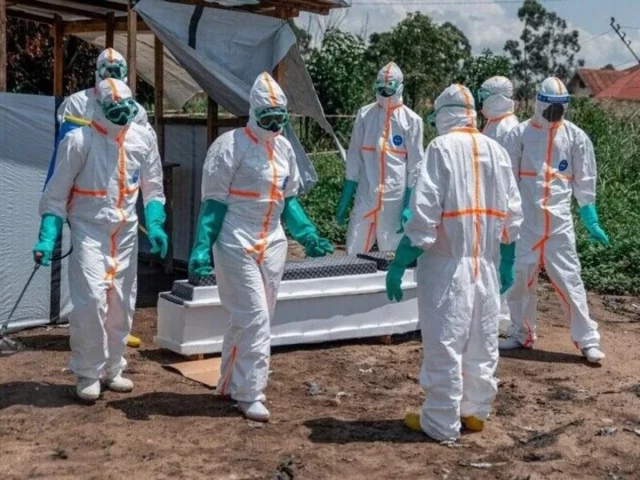
The number of confirmed Ebola cases in the Democratic Republic of the Congo has surpassed 1,800, official data showed on Saturday, as the virus spread to a fourth province in the northeastern part of the country.
The total tally reached 1,830, including 648 deaths, since the outbreak was declared on May 15, according to the health ministry’s situation update.
Some 780 patients are currently under treatment, while 284 people have recovered.
The outbreak has been concentrated in Ituri, North Kivu, and South Kivu provinces.
The ministry said the response to Ebola continues in the three provinces with “strengthened national coordination, epidemiological surveillance, and community mobilisation.”
Read: Ebola is ‘fastest growing ever’
However, on Friday, authorities reported that the outbreak spread to a new Haut-Uele province in northeastern Congo after seven fatal cases were confirmed in the Wamba health zone.
Donors and partners have pledged $910 million to support the Ebola response in Congo and Uganda, where 20 cases have been reported.
On Friday, the Africa Centres for Disease Control and Prevention (Africa CDC) said it has been strengthening the Ebola response in Congo through the deployment of multidisciplinary expert teams to priority health zones, which account for 83% of cases, as part of the decentralised response approach.
En appui au Gouvernement congolais et @MinSanteRDC, Africa CDC renforce la riposte contre Ebola en RDC à travers le déploiement d’équipes d’experts multidisciplinaires dans les zones de santé prioritaires, qui représentent 83 % des cas, dans le cadre de l’approche de… pic.twitter.com/jzKpI9P3dQ
— Africa CDC (@AfricaCDC) July 10, 2026
Africa CDC Director General Jean Kaseya said the current Ebola outbreak in Congo served as a stark reminder that “every moment counts and every delay costs lives.”
Read More: Is the world ready for another pandemic?
“That is why Africa’s ability to detect, respond, and contain outbreaks must be built where health threats emerge – in communities, through trusted health workers, strong surveillance systems, and rapid access to financing,” he said in a post on the US social media platform X.
Pandemics don’t begin in boardrooms; they begin in our communities.
The ongoing Ebola outbreak in eastern DRC is a stark reminder: every moment counts, and every delay costs lives. That is why Africa’s ability to detect, respond, and contain outbreaks must be built where health… pic.twitter.com/8WTDsaqrwg
— Dr Jean Kaseya (@Dr_JeanKaseya) July 10, 2026
On May 17, two days after the outbreak was declared in Congo, the World Health Organisation (WHO) classified the Ebola outbreak caused by the Bundibugyo strain as a Public Health Emergency of International Concern.